
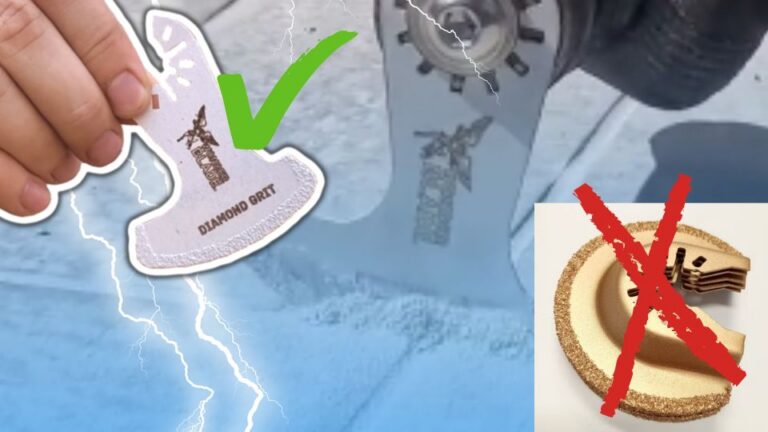
If you have ever removed grout with an oscillating multi-tool, you already know the feeling. You start a long grout line, the blade is cutting okay for the first few feet, and then it starts to slow down. You push harder. The tool gets hot. You look at the clock, then at the blade, and you realize you are not cutting anymore, you are rubbing.
That is the moment most people figure out that the blade matters just as much as the tool.
Grout is hard on blades. It is abrasive, it is dense, and it is packed into narrow lines that leave very little room to work. A blade that is not built for it will wear down quickly, and every minute you spend fighting a worn blade is a minute of labor you are not getting back. On a bathroom remodel, a kitchen backsplash, or a full floor of tile, that adds up fast.
In this article we are going to talk about the two most common types of grout blades for oscillating tools: the carbide grit half moon blade you see on the shelf at discount tool stores and home centers, and the diamond segment boot blade we make here at WonderBlade. We will cover what each one is, where each one makes sense, and why we believe the diamond boot blade is the better buy for anyone who cuts grout more than once.
A carbide grit blade is a flat steel blade, usually shaped like a half moon, with crushed carbide particles bonded along the cutting edge. Instead of teeth, the blade has a rough, sandpaper-like edge that grinds away material as the tool oscillates back and forth.
These blades are popular for good reasons. They are cheap, usually around ten dollars for a single blade. They are easy to find. They fit most oscillating tools. And they are marketed as do-it-all blades that can handle grout, tile, drywall, and even some masonry.
For a quick, one-time job, a carbide grit blade can get the work done. If you need to knock out a few inches of grout to replace a single cracked tile and you will never touch a multi-tool again, a cheap blade might be all you need.
The problem is that a lot of people are not doing a quick, one-time job. Contractors, tile setters, remodelers, and serious DIYers cut grout all the time, and for them the cheap carbide grit blade tends to turn into the expensive option.
Carbide is a hard material, but it is not the hardest. Grout, especially the sanded and cement-based kinds, is abrasive enough to wear carbide grit down quickly. As the sharp edges on those carbide particles round off, the blade stops cutting and starts polishing. You feel it as slower progress, more vibration, and more heat.
Here are the issues we hear about most from people who come to us after trying carbide grit blades.
They slow down as they wear. A carbide grit blade does not fail all at once. It gets a little worse with every foot of grout, which means you are working at less than full speed for most of the job without realizing it.
They are built to do everything. A blade that is marketed for grout, tile, drywall, and masonry is a blade that is not specialized for any of them. Grout is a very specific material, and a blade designed around it will outperform a general-purpose blade.
They cost you in blade changes. Stopping to swap blades breaks your rhythm. On a larger job, you might burn through several. That ten-dollar price tag starts looking a lot different when you buy blade number three.
They cost you in time. This is the big one. Your time on a jobsite is worth far more than the price of a blade. If a slower blade adds even a half hour to a job, you have spent more than you saved.
None of this means carbide grit blades are useless. It means they are a short-term answer to a problem that diamond grit solves better.
Our Diamond Multi-Tool Blade with the Segment Boot shape was built for one job: cutting grout. It is not a general-purpose blade, and we are upfront about that. The product page says it plainly. This blade is made for cutting grout, and it does that job extremely well.
Here is what sets it apart.
Diamond is the hardest material there is, and that matters when you are cutting something as abrasive as grout. Diamond grit holds its edge far longer than carbide grit, which means the blade keeps cutting at the same speed from the first foot of grout to the last. It is the same reason professionals reach for diamond when they cut tile, stone, and concrete.
One of our customers put it well in a review. He read through plenty of options before buying, decided to spend a little more on a blade that actually has diamonds, and said it exceeded his expectations. He used it to remove multiple grout lines, including cracked ones, and the blade was still in great condition afterward.
This is the part people notice right away. The diamond edge on the segment boot blade moves through grout very quickly, and it does it consistently. We made a short video showing just how fast it goes, and the title says it all: How to Cut Grout Instantly. When the blade is built for the material, you stop fighting the job and the grout just comes out.
Speed is not only about the cut itself. It is about the whole job. A blade that cuts quickly and keeps cutting quickly means fewer passes, less force, less heat, and less fatigue in your hand and wrist at the end of the day.
The segment boot shape is not just a design choice. It is a tool for getting into the places that make grout removal such a pain. The curved profile lets you work into corners, follow narrow grout lines, and clean up edges without gouging the surrounding tile.
Customers keep coming back to this. One remodeler used it on a bathroom project and said it cut right through narrow grout lines without leaving any visible scars on the tile. Another said the boot shape made it easy to get clean, straight cuts, which is what you need when you want a professional finish. A third explained that he had been trying to use an angle grinder to remove grout fast, but it was messy and wrecked the tile. With the boot blade he could actually control the grout line.
That control is a big deal. Removing grout is only half the job. The other half is not damaging the tile you are trying to keep.
Every WonderBlade comes with the WonderBlade Guarantee, which covers defects and breakages. We build these blades to last through many cuts of grout, and we stand behind them.
The 3-pack comes with a pair of impact resistant safety glasses made for indoor and outdoor use. Grout dust and chips are no joke, and eye protection should not be an afterthought. We put the glasses in the box so it is one less thing to buy.
Now let us talk about the part nobody likes to talk about, which is price.
Yes, the WonderBlade Diamond Segment Boot Blade costs more than a carbide grit blade. The 3-pack is $109.99, which works out to a little under $37 per blade. A carbide grit blade is around ten dollars. If you only look at the price tag on the shelf, the cheap blade wins.
But price tag and cost are not the same thing. Here is how to think about it.
Say you are a tile pro or remodeler billing around $50 an hour. You are regrouting a bathroom. With a carbide grit blade, the blade slows down partway through the job, and you end up needing a second one. Between the slower cutting and the stop to swap blades, you lose maybe half an hour. That is $25 in lost time, plus the cost of the extra blade, and you have already spent more than the difference between the two blades.
Now think about a DIYer doing a shower redo on a weekend. The time is not billed, but it is still your weekend. A faster blade that lasts through the whole job means you finish earlier and you do not make a second trip to the store.
And remember what you are buying in a 3-pack. You are not buying one blade. You are buying three, plus safety glasses, plus a guarantee. If one blade gets you through a project, you have two more ready for the next one.
When you do the math across a few jobs, the cheaper blade is rarely cheaper. You pay a little more up front for a blade that cuts faster and lasts longer, and you get that money back in saved time, fewer replacements, and a cleaner result.
That is the idea behind everything we do at WonderBlade. We want to save you time and money on the jobsite or at the house, and not waste your time on blades that do not cut.
The Diamond Segment Boot Blade 3-Pack has a 5.00 out of 5 rating across 40 customer ratings, and a lot of the feedback matches what we have been talking about here.
One customer said it cuts grout like a knife through hot butter. Another said it exceeded his expectations for grout removal. One person started a regrout project using bimetal blades from a big brand, watched them wear out quickly, switched to the diamond boot blade, and found that it lasted longer and made the whole job go faster. Another said he used a single blade for a whole bathroom project and it was still going strong.
A few reviewers also pointed out that the fine diamond grit gives you a lot of control, which helps protect the tile around the grout line. That is exactly what the boot shape and diamond edge were designed to do.
We want to be straight with you, so here is how we would break it down.
A carbide grit blade is fine if you are doing a tiny, one-time repair, you do not own many tools, and you are fine with the blade being a throwaway.
The Diamond Segment Boot Blade is the right pick if you are regrouting a bathroom, shower, kitchen, or floor, you are replacing tile and need clean edges, you want straighter lines and less damage to the tile, you do this kind of work regularly, or you value your time more than the few dollars you might save on the shelf.
If you need a blade that cuts through grout in a straight line without the boot shape, check out our Diamond Straight Head blade. And if you want one blade that handles a lot of different materials, take a look at our High-Strength Carbide Oscillating Tool Blade. It is a completely different blade from a carbide grit blade. It uses carbide teeth made for cutting fiber cement, sheetrock, plastic, concrete, screws, metal, and wood. We built it for general purpose work, while the diamond boot blade is built for grout.
If your multi-tool uses the Starlock system, we also carry a Universal Fit to Starlock adapter set so you can use our blades with it.
The cheapest blade is not always the one that costs the least. A carbide grit blade is easy to grab and easy to afford, but it wears down, slows down, and ends up costing you in time and replacements. The WonderBlade Diamond Segment Boot Blade costs a little more up front, but it cuts grout extremely fast, keeps cutting, and gets into the corners and narrow lines that make grout removal so frustrating.
You pay a little more for a better cut, and you save more time and money in the long run. For anyone who cuts grout on a regular basis, that is an easy trade.
Ready to try it? Grab the Best Diamond Multi-Tool Blade (Segment Boot Shape) 3-Pack here, backed by the WonderBlade Guarantee and shipped with safety glasses: https://wonderblade.com/diamond-oscillating-tool-blade-segment-boot
Have a question about which blade fits your project? Reach out to us through the contact page and we will point you in the right direction.
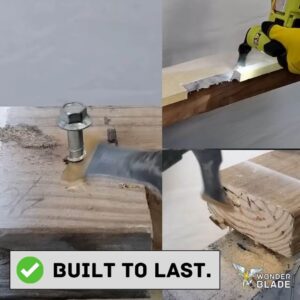
This blade stands out as one of the strongest in its industry due to its High-Strength CarbideTM teeth, known for their exceptional endurance and cutting power, as opposed to ordinary blades, which become dull over time.
*However, the major issue is that many blades that you’ll find in your local hardware store tend not to last, here at WonderBlade we have an all around General Purpose Oscillating Tool Blade that lasts time and time again against hundreds of cuts through wood, fiber cement, sheetrock, plastic and more*