
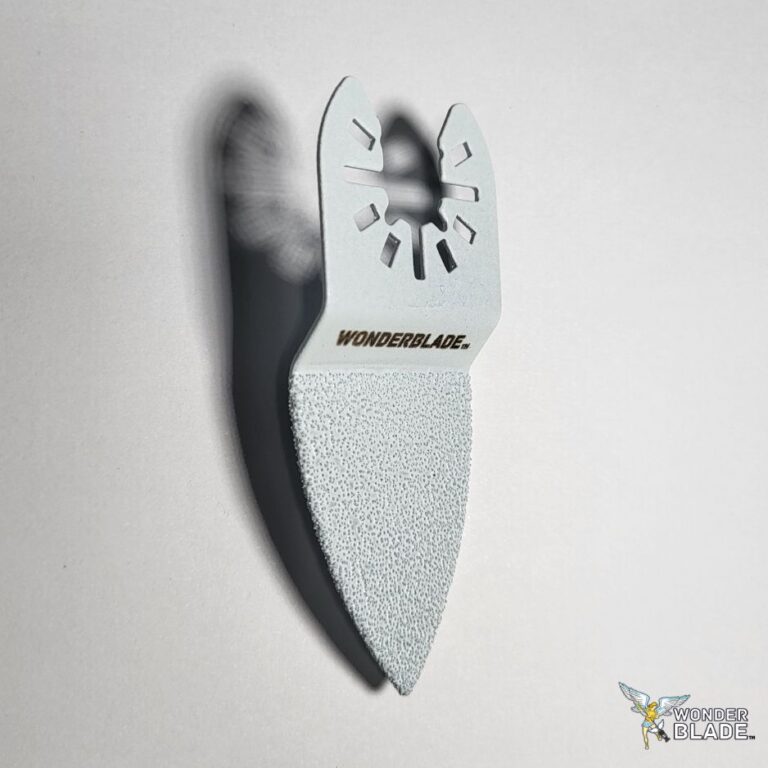
Most grout removal jobs aren’t one continuous straight line. They’re long runs mixed with tight corners, edges around outlets and fixtures, small chipped sections that need cleaning out, and detail spots where a wide blade simply won’t fit. That’s the gap the Diamond Finger Rasp Oscillating Tool Blade is built to close.
While a segment boot or straight head blade covers the bulk of a grout job, the finger rasp is the specialist for the parts of the job those wider blades can’t reach cleanly. It’s a narrow, detail-focused tool, and if you’ve ever tried to force a wide blade into a tight corner and ended up scuffing the tile next to it, you already understand why a narrower shape matters.
The finger rasp’s defining feature is its narrow profile. Instead of a wide cutting edge built for long runs, it’s shaped to get into small, awkward spaces: the corner where two walls meet, the tight strip of grout around a toilet base or vanity, the edge of a tile that’s chipped and needs cleaning out before a repair.
That narrow shape means better control in exactly the spots where control matters most. When you’re working a foot away from a fixture or right up against a finished edge, the margin for error is small. A blade that’s too wide forces you to either avoid the tight spot entirely or risk scraping the surrounding tile trying to squeeze it in. The finger rasp is built specifically so you don’t have to make that tradeoff.
Like WonderBlade™’s other diamond blades, the finger rasp uses diamond grit instead of standard teeth. That matters more here than it might seem to at first, because detail work often means more time spent in one small area, working slowly and carefully rather than pushing straight through in one pass. A standard blade under that kind of repeated, close-in work wears down fast. Diamond grit holds up under that same use without glazing over or losing its edge halfway through a small section.
The blade is purpose-built for cutting grout specifically. It’s not meant to be a general-purpose blade for wood, metal, or other materials, and using it outside of grout and tile detail work will wear it out faster without giving you a good result. Keep it dedicated to what it’s designed for and it holds up through a lot of detail work.
It’s easy to assume one wider diamond blade should be able to handle everything, corners included, if you’re just careful enough with it. In practice, that’s where a lot of time gets lost. Forcing a segment boot or straight head blade into a space it’s not shaped for usually means working slower, at an awkward angle, with a higher risk of nicking the tile next to the joint you’re trying to clean out.
Keeping a finger rasp on hand means you’re not trying to make one blade do a job it wasn’t built for. You use the wider blade for the long runs, where it’s faster and more efficient, and you switch to the finger rasp for the corners, edges, and small detail sections. That’s a fast swap, not a compromise, and it means every part of the job gets handled with the blade actually shaped for it instead of the blade you happened to already have mounted.
Customers who’ve made that switch describe a real difference. One reviewer who’d previously relied on a carbide blade for grout and tile edging said the diamond rasp held up far better over repeated cuts and reached small grout sections that other blades couldn’t get to cleanly. Another noted it was hard to find an attachment like it, and that it worked well specifically for detail cutting on grout. That’s the exact use case the finger rasp is built for: not the whole job, but the part of the job that’s hardest to do well with anything else.
Tile installers and flooring pros doing detail and finish work benefit the most. The clean edge around a fixture, the corner where two tile runs meet, the small repair section that needs old grout cleaned out before new grout goes in, these are the parts of a tile job that show if they’re done sloppily. A blade built for that precision work makes it easier to get those spots right the first time.
Bathroom and kitchen remodelers run into this constantly, since those rooms are full of exactly the tight spaces the finger rasp is shaped for: around toilet bases, vanity edges, backsplash corners, and fixture cutouts. A wide blade can handle the open floor or wall sections, but the finger rasp is what gets the finish work clean.
DIYers doing a tile repair or small regrouting job get a more specific benefit. If the job is mostly detail work to begin with, small sections, corners, a chipped tile edge, the finger rasp might be the only blade you need rather than an add-on to a wider one.
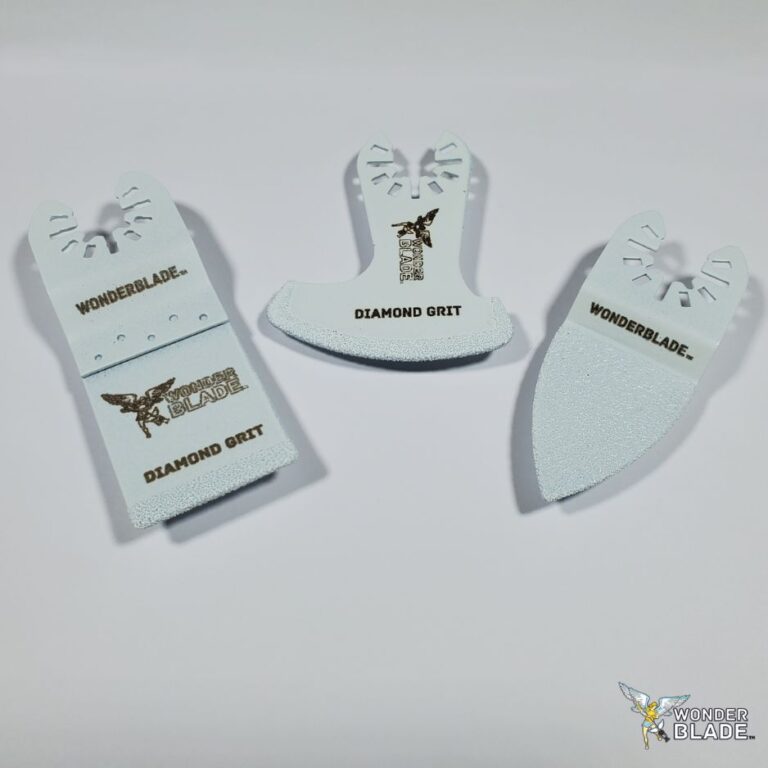
WonderBlade™ sells three diamond blade shapes, and each one earns its place for a different part of a grout or tile job.
The straight head blade is built for speed across long, consistent runs. If you’re clearing grout across an open floor with mostly straight joints, this is the shape that gets through the most ground the fastest.
The segment boot blade is the versatile middle ground, stable enough for longer stretches while still maneuverable enough to handle moderate corners and edges. It’s the shape most people reach for when a job has a mix of straight runs and some tighter spots.
The finger rasp is the narrowest and most specialized of the three, built specifically for the tightest corners, fixture edges, and small detail sections where the other two shapes are too wide to work cleanly. On a full tile job, it’s common to use more than one shape: the straight head or segment boot for the bulk of the work, and the finger rasp for the finish detail that makes the job look clean.
The Diamond Finger Rasp Oscillating Tool Blade comes as a 3-pack for $99.99. Compared to a single generic blade off a hardware store shelf, that’s a real price difference, and it’s fair to ask what you’re getting for it.
What you’re paying for is a blade that’s actually shaped and coated for a specific job most blades aren’t built for at all. A wide multi-purpose blade forced into detail work either can’t get into the space or does a rough job trying. The finger rasp does that job cleanly, and the diamond coating means it holds up through repeated detail cuts instead of dulling out after the first tight corner. For a tile professional running detail work regularly, or a homeowner tackling a bathroom’s worth of fixture edges and corners, three blades built to actually finish the job right is worth more than a drawer of blades that can’t reach half the spots you need them to.
Every Diamond Finger Rasp Oscillating Tool Blade is backed by the WonderBlade™ Guarantee, which covers manufacturer defects and breakage. It’s not a substitute for using the blade the way it’s meant to be used, on grout and tile detail work specifically, but it takes the risk out of trying a specialty blade for the first time.
Most of a grout or tile job can be handled by a wider blade moving fast across long, straight runs. It’s the corners, the fixture edges, and the small detail sections where that same wide blade starts working against you. The Diamond Finger Rasp Oscillating Tool Blade is shaped specifically for that part of the job: narrow enough to reach tight spaces cleanly, coated with diamond grit to hold up through repeated detail cuts, and backed by a guarantee if something goes wrong. For anyone doing tile or grout work where the finish details actually show, it’s the blade that gets those spots done right instead of rushed.
If “best value” means finishing more work with fewer blades, fewer swaps, and cleaner results, the winner is clear:
➡ WonderBlade™ High-Strength Carbide™ Oscillating Tool Blade
Built for general-purpose, multi-material cutting with the durability and control pros expect—and the versatility DIYers need.
Shop the blade:
https://wonderblade.com/high-strength-carbide-oscillating-blade-1
Learn more about WonderBlade™:
https://wonderblade.com
Watch the comparison video:
https://www.youtube.com/watch?v=b01S7eoalKw
This blade stands out as one of the strongest in its industry due to its High-Strength CarbideTM teeth, known for their exceptional endurance and cutting power, as opposed to ordinary blades, which become dull over time.
*However, the major issue is that many blades that you’ll find in your local hardware store tend not to last, here at WonderBlade we have an all around General Purpose Oscillating Tool Blade that lasts time and time again against hundreds of cuts through wood, fiber cement, sheetrock, plastic and more*